Understand · Longevity Coach article
What Old Dogs Can Teach Us About the Ageing Brain
A small study of senior dogs found brain changes relevant to ageing research—but dogs do not have human Alzheimer’s disease, and the findings are not a diagnostic test.
By Longevity Coach Editorial Team ·
Topics: brain ageing · dementia research · dogs · research models · healthy ageing
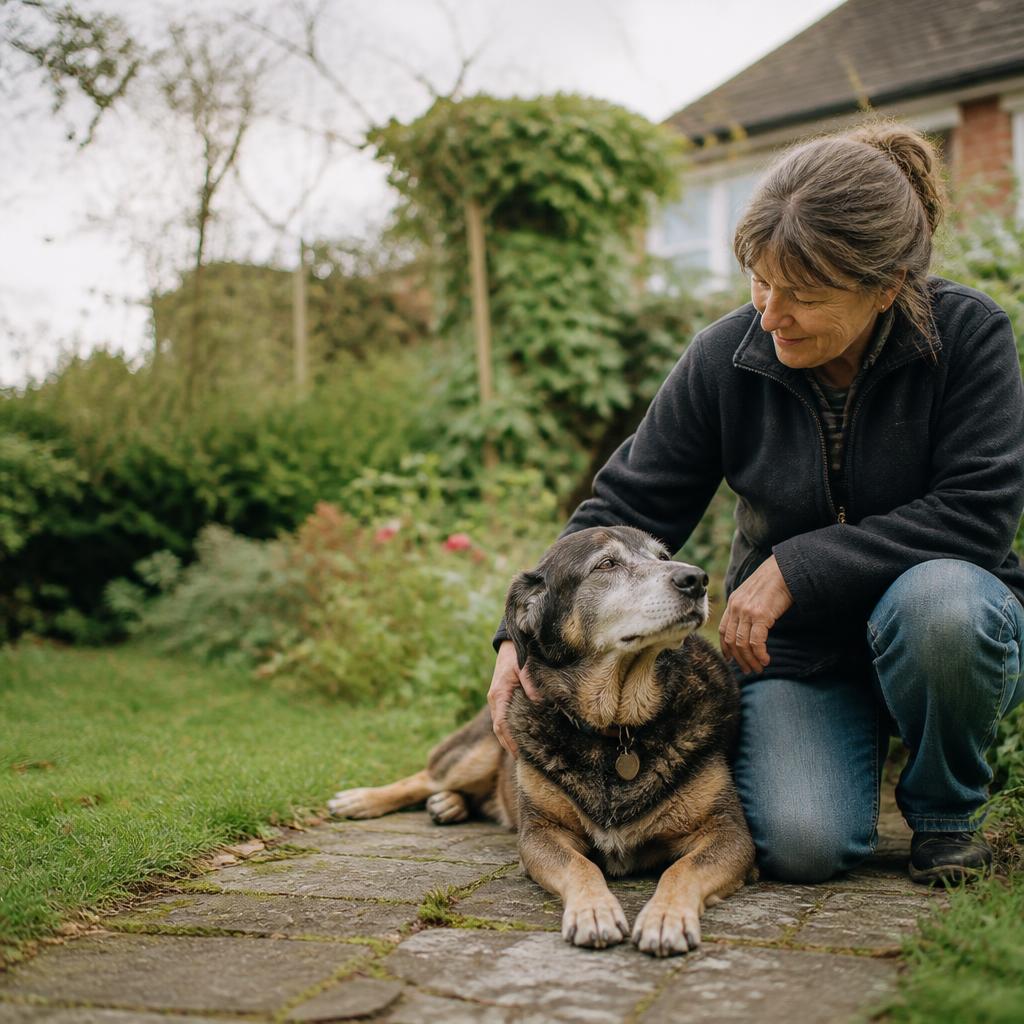
When an older dog becomes less responsive to a familiar cue or seems unsettled in a well-known room, it can be hard not to wonder what is happening in the brain. Researchers are asking related questions: what changes with age, why do some older individuals show more cognitive difficulty than others, and which parts of those changes can be studied safely and usefully?
A recent study examined brain tissue from senior pet dogs and reported patterns that may help researchers investigate age-related brain changes. It is an interesting contribution to ageing research, not evidence that dogs develop human Alzheimer’s disease, not proof that dog ownership protects people from dementia, and not a test that can diagnose either species.
The short answer
What can older dogs teach us about the ageing brain?
They may help researchers study how brain changes and cognitive function vary during natural ageing. In one small postmortem study of 24 senior dogs, researchers found amyloid-beta deposits and variable tau changes, with some differences related to cognitive status. Dogs are a complementary research model, not a stand-in for people. The study does not show that dogs have human Alzheimer’s disease, that dog ownership prevents dementia, or that a blood test can diagnose brain disease.
Ageing does not follow one script
Ageing is often described as if everyone moves through the same sequence at the same speed. In reality, people—and animals—differ. Some older adults remain cognitively capable, while others experience changes that affect memory, language, judgement or daily life. The reasons are complex and can include biology, health, environment and chance.
That variation is important to research. If scientists study only a single idealised version of ageing, they may miss why some individuals are more resilient or why particular brain changes matter in one context but not another. Companion dogs offer one way to observe ageing as it occurs in ordinary life, rather than only in carefully controlled laboratory settings. But a useful model is never an identical copy of human ageing.
What did the dog-brain study examine?
In a paper published in npj Dementia in October 2026, Alsulami and colleagues analysed postmortem brain tissue from 24 client-owned senior dogs. The researchers examined the distribution of amyloid-beta (Aβ) and phosphorylated tau, proteins that are also studied in human neurodegenerative research, and considered how those tissue findings related to cognitive assessments and blood biomarkers.
They reported Aβ deposits in the dogs’ brains and phosphorylated tau in some animals, with tau changes varying between dogs and brain regions. The study did not identify neuritic plaques—the mature, complex structures associated with human Alzheimer’s neuropathology. Aβ burden was greater in dogs assessed as cognitively impaired than in those without impairment, but the amount and distribution of pathology varied. Age was the strongest predictor of Aβ burden in this small sample.
These observations add detail to a developing picture of canine brain ageing. They do not establish a single disease pathway, explain every behavioural change in older dogs, or show that the same tissue pattern produces the same symptoms in people. Postmortem tissue can reveal biological features that a behavioural questionnaire alone cannot, but it represents a limited snapshot of selected animals rather than a population-wide map.
Similar proteins do not mean the same disease
Researchers study Aβ and tau in several species because these proteins are involved in brain biology and can change in disease. Finding a related protein in another species is not enough to conclude that the species has the same illness. The form, location, timing and surrounding brain changes all matter, as do the ways cognition is assessed.
Dogs can develop age-related cognitive and behavioural difficulties sometimes described clinically as canine cognitive dysfunction syndrome (CCDS). That term does not make CCDS the canine version of human Alzheimer’s disease. The two conditions are not interchangeable labels, and a research finding in dog tissue should not be translated directly into a claim about a person’s diagnosis or future.
Veterinary guidance also stresses that signs associated with CCDS—such as changes in sleep, activity, learning or interaction—are not specific to one condition. A 2026 Canine Cognitive Dysfunction Syndrome Working Group guideline describes CCDS as a diagnosis of exclusion. That is a reminder about the limits of symptom-based interpretation, not a way for this article to assess an individual animal.
Why study dogs at all?
Dogs share many parts of human environments: homes, social contact, daily routines and, in some cases, exposures such as urban air pollution. They also age over a shorter lifespan than people. These features may help researchers ask questions about naturally occurring ageing across a lifetime and investigate how biology interacts with lived conditions.
Projects such as the Dog Aging Project follow companion dogs over time, using owner-reported and, in some studies, veterinary and biological data. This can reveal patterns across a lifespan in fewer years than human studies. But canine lifespan is not a compressed human lifespan, and findings do not transfer automatically.
Dogs therefore complement other approaches, including human studies, laboratory models and cell-based research. No one model answers every question. A result in dogs can help generate hypotheses, point to possible mechanisms or guide further study; it cannot by itself settle what happens in human ageing.
What the study cannot tell us
The sample was small: 24 dogs. Tissue could be described in detail, but the results cannot be confidently generalised to all dogs, breeds or living conditions. Dogs available for postmortem research may differ from the wider population. The design shows associations, not that a protein change caused a dog’s cognitive state.
Behavioural assessments have their own constraints. Dogs cannot complete the same language, memory and reasoning tests that people can, and an owner’s observations are not identical to a clinical cognitive assessment. Other health changes can affect behaviour too. Researchers have to interpret the measures available for each species rather than assume that a familiar human test has a direct canine equivalent.
The study is not a trial of a treatment or prevention strategy. It does not demonstrate that a particular diet, supplement, activity, breed, household or relationship prevents cognitive decline. Nor does it show that living with a dog reduces a person’s dementia risk. Those would require different human evidence.
GFAP is a research clue, not a routine diagnosis
The researchers also reported that plasma glial fibrillary acidic protein (GFAP) was positively associated with Aβ plaque burden in their dog sample. GFAP is a protein studied as a possible marker of changes involving astrocytes, a type of brain-supporting cell. A correlation in a small exploratory study can help researchers decide what to investigate next; it does not show that GFAP identifies the cause of a change or accurately classifies an individual dog.
There is also a reason to be cautious about presenting this as a settled canine biomarker. A separate 2025 study of canine blood biomarkers did not find a statistically significant relationship between GFAP and cognitive scores in its sample. Differences in study design, participants, assays and outcomes can help explain why findings do not always match. Further validation would be needed before interpreting GFAP as a useful clinical measure in dogs, let alone as a human test.
GFAP is not a routine diagnostic test for dementia in people. This dog study does not change that. A research association should not be turned into a screening claim, a personal risk estimate or a reason to seek an unvalidated test.
What this may mean for human ageing research
The most useful message is about variation and method. Natural ageing includes a wide range of experiences, and companion dogs may help researchers investigate some biological changes in real-world settings. Their value lies in adding another perspective, not in replacing human evidence or making the biology of two species seem identical.
For researchers, the next questions include whether these findings can be replicated in larger and more diverse groups of dogs; how tissue changes relate to carefully characterised cognitive function; and whether candidate blood markers perform consistently across studies. Human research would still be needed to establish what any related finding means for people.
For readers, the distinction is simpler: an intriguing animal study is a starting point for research, not a forecast about your own brain. If you are interested in how research separates promising signals from established knowledge, see our guide to how Longevity Coach thinks about evidence and our article on brain health and vascular health.
Common questions
Do dogs get Alzheimer’s disease?
Dogs can experience age-related cognitive and behavioural changes, and canine cognitive dysfunction syndrome is recognised in veterinary medicine. That is not the same as saying dogs have human Alzheimer’s disease. Similarities in some biological features do not establish identical diseases.
Does this research mean dog ownership prevents dementia?
No. The study examined dogs’ brain tissue; it did not test whether owning a dog changes a person’s dementia risk or prevents dementia.
Can a GFAP blood test diagnose dementia?
No. The reported dog finding is exploratory, another canine biomarker study did not find a significant GFAP–cognition association, and GFAP is not a routine dementia diagnostic test for people.
Are dogs better research models than mice?
Not categorically. Dogs may offer insights into naturally occurring ageing in shared environments, while mice and other models answer different questions under different conditions. Human studies remain essential for conclusions about people.
Sources / Further reading
- Alsulami et al. Alzheimer’s disease neuropathological characterization of the dog brain and relationship to biofluid biomarkers and cognitive function. npj Dementia (2026). DOI: 10.1038/s44400-026-00141-4.
- Canine cognitive biomarker study. BMC Veterinary Research (2025). DOI: 10.1186/s12917-025-05027-w.
- Canine Cognitive Dysfunction Syndrome Working Group: clinical guidelines. Journal of the American Veterinary Medical Association (2026).
- Creevy et al. The Dog Aging Project: translational geroscience in companion dogs. Nature (2022). DOI: 10.1038/s41586-021-04282-9.
Editorial note
This article discusses early-stage animal research for general education. It does not diagnose or predict cognitive disease in people or animals, and does not provide treatment or prevention advice.