Move · Longevity Coach article
Why Dance Might Be One of the Cleverest Ways to Exercise
Dance can blend aerobic movement with memory, balance, coordination and social connection. The research is promising, but it does not show that dancing beats walking or prevents dementia.
By Longevity Coach Editorial Team ·
Topics: dance · brain health · balance · movement · healthy ageing
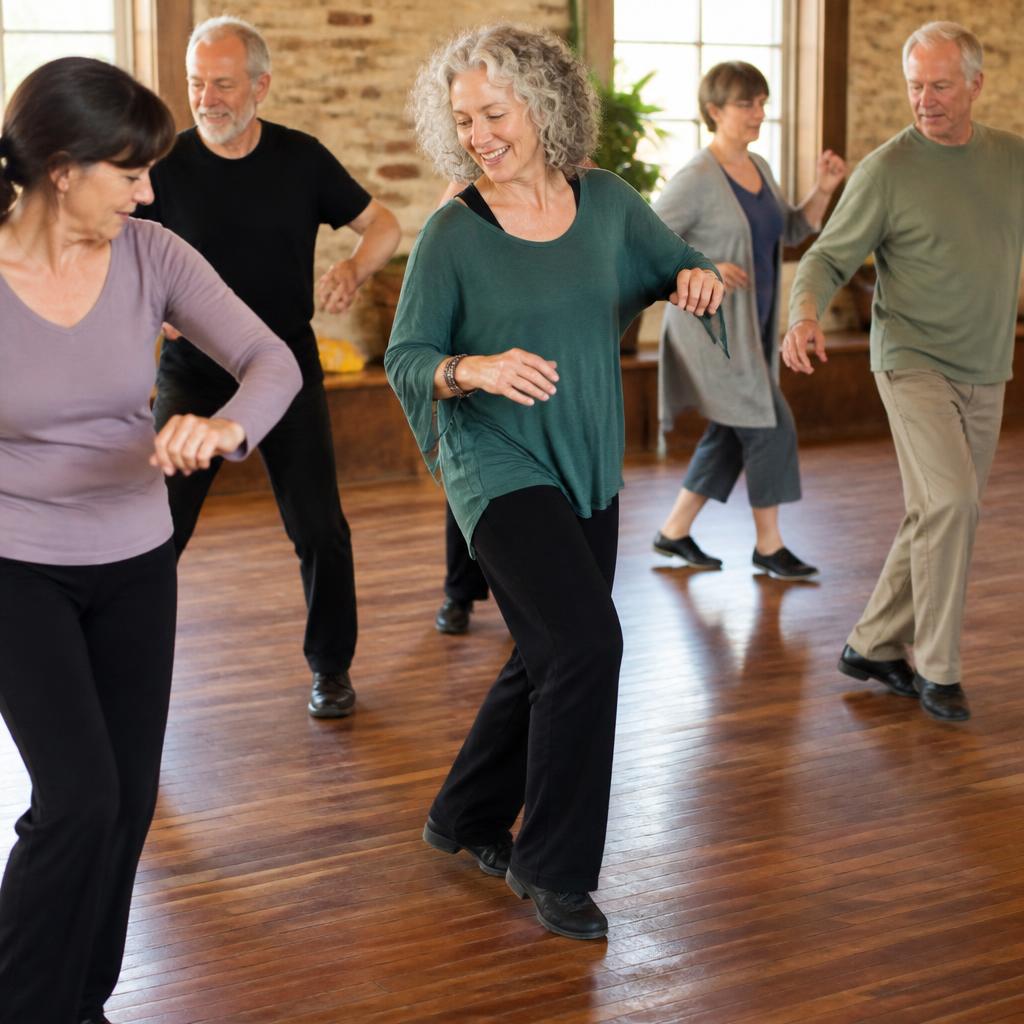
Some exercise asks you to put one foot in front of the other for a while. Dance asks what the other foot is doing, whether the music has changed, where the people around you are, and whether you can remember the next few steps. It can be a workout, a small puzzle and a social occasion at the same time.
That combination is why researchers are interested in dance as a way to support movement and brain health. It is not because dance has been shown to be a superior replacement for walking, cycling or other aerobic exercise. The more careful idea is that some forms of dance bring several useful demands together, and people may find that mix more enjoyable and easier to keep doing.
One activity, several kinds of practice
A brisk walk or a treadmill session can challenge the heart and lungs, build endurance and help make everyday movement feel easier. These are valuable outcomes in their own right. Dance may add more moving parts: learning a sequence, keeping time, shifting weight, changing direction, coordinating arms and legs, watching other people and reacting when the pattern changes.
Those tasks involve attention and motor learning. A partner dance may also involve communication and shared timing; a class can create routine and connection. A solo dance workout still has movement and sequencing, even without the social element. What matters is what the activity actually asks of you, not whether it carries the label “dance”.
Researchers call activities that challenge more than one system multidomain. In plain English, it is practice that does not isolate fitness from balance, coordination or attention. A walk on a familiar route may be mostly automatic; a new route with hills, navigation and a friend is a richer task. This is not a ranking. Different activities train different things.
What the dance studies found
In an 18-month study, older adults were assigned to a dance programme that introduced changing choreographies or to a conventional fitness programme including endurance, strength-endurance and flexibility work. Both groups showed changes in parts of the hippocampus, a brain region involved in memory and spatial learning. The dance group also improved on a balance measure. The wider research programme measured brain-derived neurotrophic factor (BDNF), a possible biological mediator of exercise-related brain changes; it is a marker under study, not evidence that dance prevents disease. Only 26 people completed this study, the groups were small, and the researchers cautioned that the findings needed confirmation.
That study is interesting because it compared dance with an active exercise programme rather than with doing nothing. It does not show that dance grows the whole brain more than cardio, or that a change on a brain scan necessarily translates into a meaningful difference in daily life. The evidence is best read as a reason to study complex movement further, not a verdict on which exercise is best.
A later randomised trial compared six months of social ballroom dancing with treadmill walking in adults aged 65 and older who had markers of higher dementia risk. Twenty-five people were enrolled, but only 16 completed the programme before the study was interrupted by the COVID-19 pandemic. Executive-function scores improved in both groups, with no clear difference between them on the main combined measure. One test favoured dance, and some brain-imaging findings were exploratory. The small sample means those details are a starting point for a larger trial, not proof that dance prevents dementia.
Reviews of dance studies have reported possible benefits for some measures of balance, mobility or cognition. The studies differ in their participants, dance styles, frequency and comparison groups. A short-term change on a test is not the same as preventing a diagnosis years later. That distinction matters whenever a lively activity is presented as a brain treatment.
Why the enjoyable option can be the practical one
An activity does not have to win a head-to-head trial to be worth doing. If you enjoy dancing enough to return to it, that may matter more than a theoretical edge on a lab measure. A class can make movement part of the week, offer a reason to leave the house, and give you a skill to practise with other people. A walk can do those things too, especially if it is social or takes you somewhere new.
There is also no requirement to build a second job out of your health routine. Some people like a separate strength session, a walk and a class. Others would rather choose one activity that includes several elements. The useful question is whether your week contains movement that fits your body and life, not whether you have assembled the ideal exercise portfolio.
Learning can matter more than choreography
You do not need a complicated routine or a polished performance. The interesting part may be noticing a new rhythm, remembering a short sequence, or adjusting when the instructor changes direction. A beginner class often offers this naturally; if you already dance, trying a different style can make familiar movement feel new again.
There is a difference between casual movement and practising a skill, but neither is the “right” version. Kitchen dancing can make an ordinary evening more joyful and get you moving. A class can add feedback, a sequence to learn and other people to notice. Choose what you want from the hour. If the main aim is a cardiovascular workout, ask how vigorous the session is: some classes are energetic, while others focus more on social movement and steps.
It is also fine for your exercise week to include other kinds of effort. Dance need not replace strength work, walking or anything else you value. Think of it as one useful option, not a complete prescription disguised as a playlist.
Make movement richer
If dance appeals to you, try a beginner class, line dancing, salsa, folk dance, a dance-fitness session or a routine at home. The most cognitively demanding part may be learning something unfamiliar and gradually getting more comfortable with it. Repeating a familiar routine can still be enjoyable movement; you do not need to keep increasing the difficulty to justify it.
If dance is not your thing, similar combinations appear in racket sports, martial arts, climbing, hiking with navigation, group exercise and learning new movement patterns. You might take a different route, practise stepping over uneven ground safely, or ask a friend to join you. Novelty is an invitation, not an obligation.
For more on choosing activities that ask the brain to learn, see our guide to brain training and meaningful activities. Our article on movement and physical freedom looks at capability across everyday life, and this piece on friendship and connection explores why relationships are part of wellbeing too.
If you are working out what you want more of in the next part of life, our guide to life design and ageing starts from the activities and relationships you want to make room for. Exercise can support that picture without becoming the whole picture.
Adapt it to the person, not the poster
Dance classes vary in pace, impact and balance demands. A seated class, smaller steps, a chair nearby, a slower tempo or a supportive instructor can make an activity more accessible. If you have significant balance or mobility problems, a heart condition, recent surgery, chest pain, unexplained breathlessness or another health concern, ask a clinician or physiotherapist what kind of activity is suitable before starting something vigorous.
Stop and seek advice if exercise brings symptoms that are new or worrying. A class should be adaptable; pushing through pain or dizziness is not a test of commitment. The NHS physical-activity guidance is a useful broad reference, but personal circumstances can change what is sensible for you.
The point is not to beat the treadmill
Dance is promising because it can bring physical effort, learning and connection into one activity. The studies so far are small and do not establish that dance is better than conventional exercise or that it prevents dementia. Walking, strength work, cycling and other movement remain worthwhile.
If dancing makes you want to move, that is enough reason to give it a try. If another activity fits you better, choose that. Your brain and body do not need to be trained in separate rooms, but neither do they require one perfect class.
Sources / Further reading
- Rehfeld et al., Frontiers in Human Neuroscience (2017): a small 18-month comparison of dance and conventional fitness training.
- Blumen et al., Journal of Aging and Physical Activity (2023): preliminary ballroom-dancing and treadmill-walking trial findings.
- NHS: Physical activity guidelines for adults.