Improve · Longevity Coach article
What Job Is Alcohol Doing for You?
If you want to drink less, start by noticing when you reach for a drink and what it provides. Then build a realistic alternative that fits your evening.
By Longevity Coach Editorial Team ·
Topics: how to drink less alcohol · alcohol habits · evening drinking habit · alcohol and stress · sober curiosity
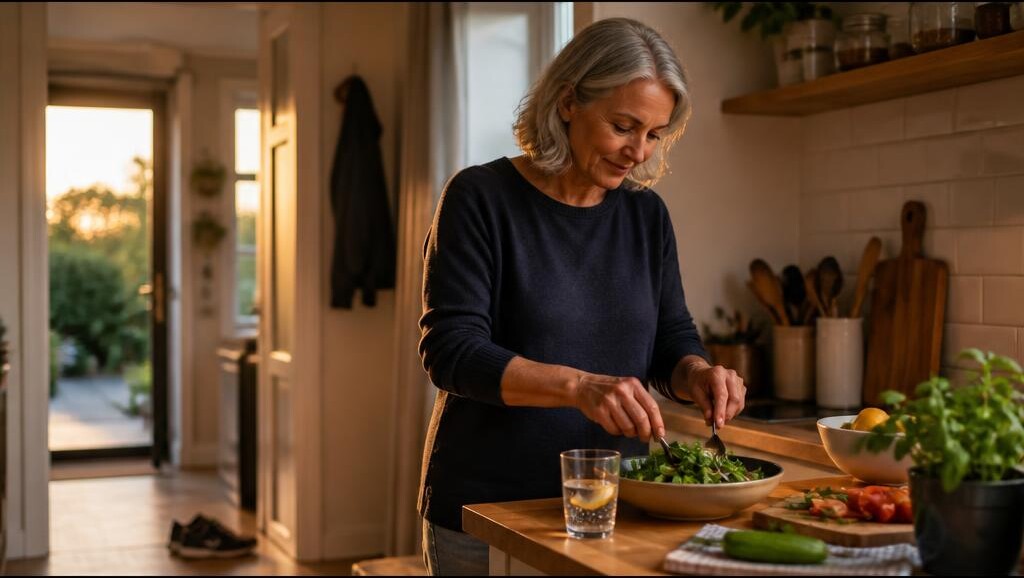
You decide to drink less. Then six o’clock arrives: the same workday, the same kitchen, the same chair and the same feeling that the day is finally over. You have removed the drink, but not the moment it used to mark.
That is why “I’ll drink less” can be a clear goal without yet being much of a plan. A drink may be doing a job: helping you switch off, rewarding you, filling a quiet evening or making a social situation feel easier. Noticing the job does not excuse harm or make alcohol the right answer. It gives you a more useful question than “Why can’t I just stop?”
A goal is not the same as a process
A goal might be, “I won’t drink this week.” A process describes what happens instead: “At the end of work, I put my laptop away, change clothes, take a short walk, make a drink I enjoy and start dinner.” That is only an example; not everyone wants a fixed routine, and a walk is not a treatment for alcohol problems. The point is to give the old cue a different route into the evening.
When you understand what you wanted from the drink, you can choose a replacement that has a chance of meeting that need. It might be a transition, a reward, company or something to look forward to. It does not have to be productive or impressive.
The cue, the routine and the expected reward
A simple way to look at a repeated behaviour is:
Cue: work finishes.
Routine: pour a drink.
Expected reward: relief, a treat, a sense of freedom or permission to relax.
This is a sketch, not a complete explanation of why people drink. Habit research describes how familiar situations can cue repeated actions; changing the situation or practising another response may help some everyday routines shift. Alcohol use is more complicated than a habit loop, though. Health, stress, social life, availability and dependence can all matter.
Researchers also study different motives, such as coping with difficult feelings, seeking enjoyment, joining in socially or avoiding standing out. A systematic review of 64 studies using reports from people’s daily lives found mixed evidence and noted that the field does not yet capture every moment-to-moment influence well. These are prompts for curiosity, not fixed “drinking types”, diagnoses or proven labels for you.
Five questions: what job is your drink doing?
- When do I most expect a drink? Notice the time, place, people and what has just happened.
- What feeling tends to come first? Stress, boredom, relief, loneliness, anxiety, excitement or simply familiarity?
- What am I hoping the drink will give me? A transition, a reward, confidence, connection, relaxation or escape?
- What else might offer some of that same reward? It need not work in exactly the same way.
- What could I change before the urge arrives? The time, place, people, purchase or first step of the evening?
You do not need to answer perfectly. A rough pattern is enough to test one small change.
Common jobs a drink can do
The off switch
If work has no clear ending, try a transition that suits you: change clothes, shower, listen to music, cook, read, go outside or put work messages away. It can mark the move home; it is not a treatment for dependence.
The reward
“I’ve earned this” is a real desire, not something to mock. Ask what would feel like a reward tonight: a favourite meal, a film, a bath, a hobby, a call or simply stopping work properly. The replacement need not become another self-improvement assignment.
The social passport
If everyone around you is drinking, fitting in may be harder than choosing a drink. Decide what to order before you arrive, keep an alcohol-free option in hand, tell one trusted person what you want or leave earlier if useful. You do not owe anyone a speech.
The boredom filler
A drink can give an empty evening a shape. Consider one thing to look forward to after dinner: a call, a class, a book, music or a shared task. A better evening need not be a busier one.
The emotional anaesthetic
Some people drink to get distance from grief, anxiety, loneliness, trauma, relationship strain or work pressure. A new ritual may not address what is underneath. A GP, counsellor or local alcohol service can help you consider support. Our guides to stress and healthy ageing and connection through life changes are further reading, not a substitute for care.
Replace the function, not only the liquid
An alcohol-free beer or wine may help if the familiar glass or ritual is what you want to keep. It may do little if you drink to escape a painful feeling or cope socially. Choose a different reward, build a transition, give an empty evening some shape, or seek support for what you are trying to get away from.
The replacement need not reproduce alcohol’s effects; it should address roughly the same need in a way that feels acceptable. If it does not help, that is information, not a personal failure.
Change the setting before the urge arrives
Small changes to your surroundings can interrupt an automatic sequence: stop buying alcohol on the usual shopping trip, move it out of sight, use a different glass, start the evening in another room or plan for a social event before you arrive. This is not a test of willpower; it makes the next choice easier to notice.
Drinking less, taking a break or stopping
There is no single goal that fits everyone. Some people want fewer drinking days, smaller amounts, alcohol-free weekdays or a period without alcohol. Others choose complete sobriety. For some, moderation is difficult or not the safest option; for others, reducing is the change they want to explore. You do not need to adopt someone else’s identity or explain your choice.
If you drink most weeks, current UK Chief Medical Officers’ guidance says it is safest not to regularly drink more than 14 units a week to keep health risks low. If you regularly drink that amount, spreading it over three or more days and having several drink-free days can help keep risk lower. Fourteen units is not a risk-free allowance or a personal target. Alcohol can affect sleep and wellbeing, and regular drinking increases the risk of conditions including some cancers and liver disease. Cutting down may reduce exposure, but there is no guaranteed immediate result. The NHS guide to alcohol units explains the UK advice and how units are counted.
Important: check safety before stopping suddenly
Alcohol dependence is not just a habit to replace. If you drink heavily or most days, need a drink in the morning, or wake with anxiety, sweating, shaking, nausea or retching, get medical advice before reducing or stopping. These signs do not diagnose dependence, but they deserve an assessment. If you are physically dependent, stopping overnight can be harmful and may require medical support. Do not try a do-it-yourself detox or use this article as a withdrawal plan.
Call 999 for severe withdrawal symptoms such as hallucinations, severe tremors or a seizure. The NHS alcohol support guide explains how to contact a GP or local alcohol service and what symptoms need emergency help.
A seven-day observation experiment
Only try this if you can safely change your drinking. It is not a detox or a reason to stop suddenly. For one week, notice the time and place, what happened just before, how you felt, what you wanted and the reward you expected. You do not need to count calories or every unit to spot a pattern.
At the end of the week, choose one recurring situation and one alternative routine to test. For example:
Old sequence: finish work, go to the kitchen, open wine, sit down and feel the day is over.
Possible new sequence: finish work, change clothes, take a short walk or shower, make an alcohol-free drink while dinner cooks, then settle in.
The walk is not the magic ingredient. The useful change may be that the new sequence gives the evening a beginning. Try it, notice whether it meets the need, and adjust. If it does not, ask again what the drink was doing. If you notice withdrawal symptoms, stop the experiment and seek medical advice before making changes.
Build a life where the drink has less work to do
Changing alcohol use need not become a full-time project of tracking and resisting. A small routine may be enough; bigger challenges may need support. If sleep or stress is part of the pattern, see our pieces on sleep and brain health and chronic stress. If a walk suits you, our article on movement and physical freedom explores activity in real life.
Longevity Coach’s Life Design approach starts with what matters, then makes space for realistic processes rather than demanding perfect goals. The Life Design guide is one place to begin. The aim is not to become brilliant at resisting a drink every evening. It is to build a life where the drink has less of a job to do—and to ask, with curiosity rather than blame: “What am I asking alcohol to do for me, and is there another way to get some of that?”
Sources / Further reading
- UK Chief Medical Officers, Low Risk Drinking Guidelines (2016).
- NHS, Tips on cutting down on alcohol (reviewed April 2026).
- NHS, Alcohol support (reviewed August 2026).
- Votaw and Witkiewitz (2021), “Motives for Substance Use in Daily Life: A Systematic Review of Studies Using Ecological Momentary Assessment”, Clinical Psychological Science.
- Gardner, Lally and Wardle (2012), “Making health habitual: the psychology of habit-formation and general practice”, British Journal of General Practice.
This article is for general education, not personal medical advice, diagnosis or treatment. If you are worried about your drinking, speak with a GP or local alcohol service. If you may be physically dependent, do not stop suddenly without medical advice.